MVRDV
Venue
Opening hours
Hashtag
Overview
For the eighth edition of DOMa Lectures, DOMa welcomed MVRDV from Rotterdam, continuing a lecture series that invites both established and emerging architectural practices to present their work through a retrospective lens while relating it to the broader conditions shaping contemporary architecture.
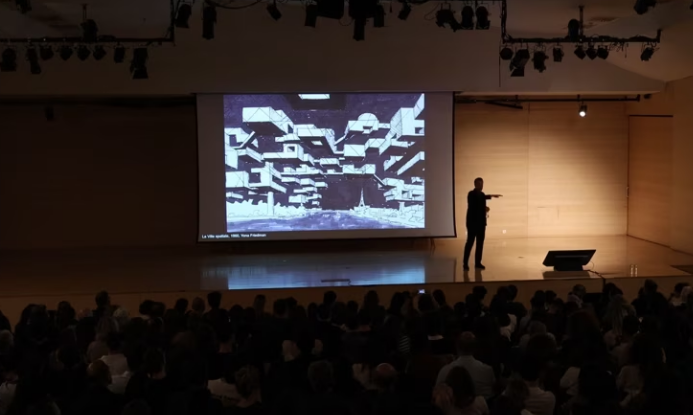
The evening was introduced by Giorgos Panetsos of DOMa, who framed the work of MVRDV around two recurring principles: a commitment to architecture as a discipline shaped by accumulated conventions, and an equally strong belief in change—not merely as something to adapt to, but as something architecture can actively pursue. Representing MVRDV, Bertrand Schippan opened his lecture, titled Resilient Future(s), with a direct statement: “Tonight we will talk about changes.”
The presentation focused on the role architecture can play in responding to climate change, biodiversity loss and environmental degradation. Rather than approaching these conditions as abstract or distant threats, Schippan grounded the discussion in the case of Thessaloniki, examining the long-term effects that rising sea levels could have on the city. This became the starting point for a broader presentation of MVRDV’s scenario-based methodology, in which research, data collection, digital tools and speculative modelling are used to anticipate future conditions and develop architectural responses to them.
From this framework, Schippan outlined four interconnected strategies. The first concerned the need to introduce substantially more greenery into cities through a “cool-down” approach, with planted roofs and green buildings becoming part of a wider shift from designing buildings to, in part, designing nature itself. The second called for a new “culture of risk”: rather than attempting to isolate cities from changing environmental conditions, architecture and urbanism must learn to coexist with them, particularly with water.
A third strategy argued for making cities “more compact” rather than rejecting density and development altogether. Referring specifically to Athens, Schippan highlighted the largely unused potential of the city’s roofscape, imagining it as an additional urban layer capable of accommodating greenery, cultivation and new forms of collective life. The fourth strategy focused on carbon neutrality, approached by MVRDV less as an abstract performance target than through a pragmatic problem-solving mentality in which materials and construction choices are calibrated to the requirements of each project.
Throughout the lecture, recent MVRDV projects were used to demonstrate how these principles can move from research and speculation into architectural practice. What emerged was a conception of the architectural office as both design studio and research laboratory: a place where existing problems are deliberately amplified, modelled and projected into possible futures in order to develop responses before those futures become unavoidable realities.
The central proposition of the evening was therefore not one of retreat in the face of change, but of ambition. For MVRDV, resilience requires architects to “think big”, to engage directly with transformation and risk, and to integrate new environmental realities into everyday urban life rather than attempt to exclude them.
The lecture concluded with a conversation between Bertrand Schippan and Giorgos Panetsos, followed by questions from the audience. The discussion ranged from the evolution of MVRDV’s practice and its relationship with clients and public authorities to the incorporation of artificial intelligence into architectural design, the implications of performance indicators for green architecture, and the broader question of how environmental targets might reshape—or potentially constrain—the architectural act itself.
Presentation
View: